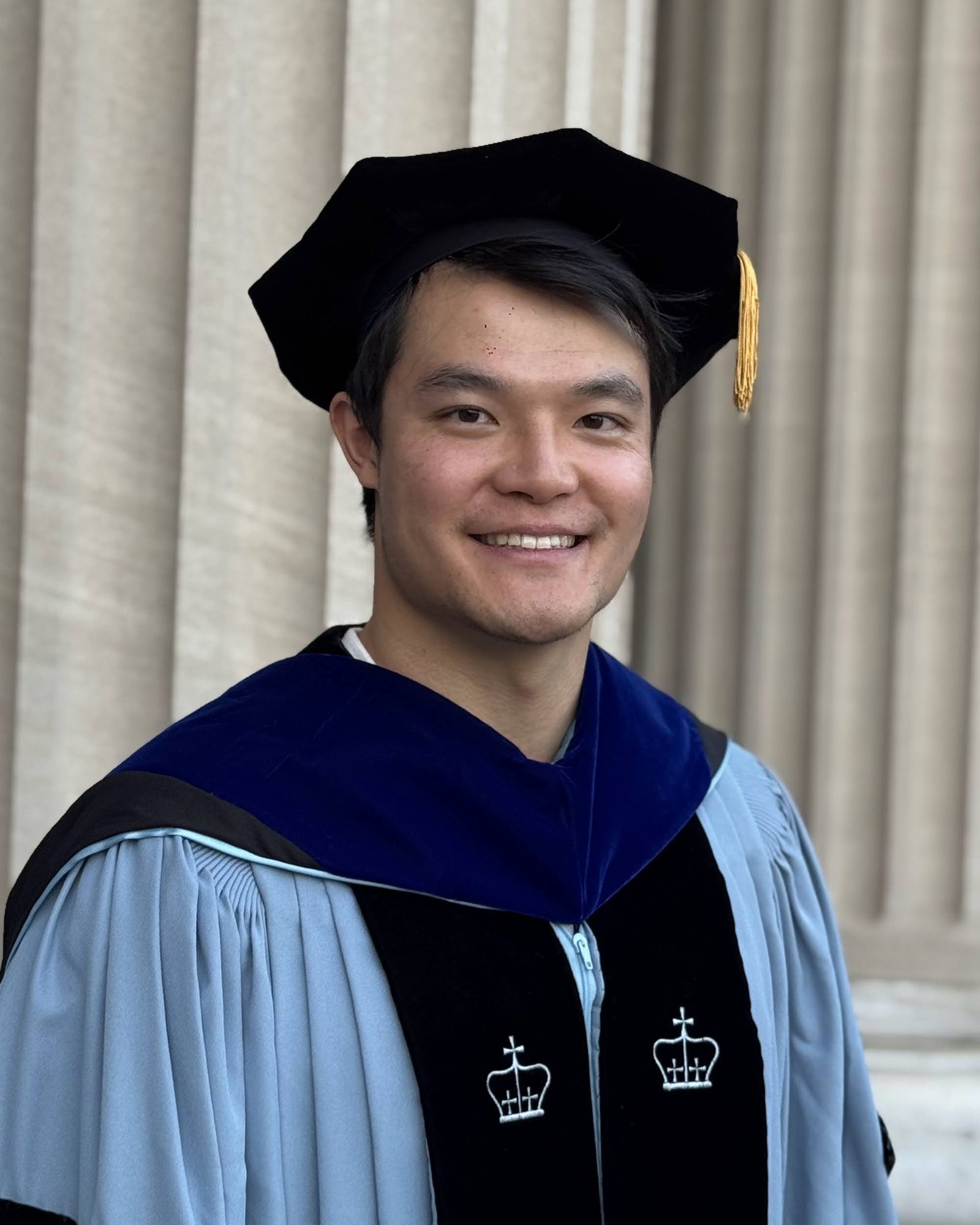
PhD, Biomedical Engineering · Columbia University

I build and evaluate wearable devices and digital health systems.

I work at the intersection of sensor hardware, signal processing, and clinical evidence — taking wearable sensing from prototype through human subjects validation to something people can actually rely on. Currently a postdoctoral fellow at Columbia University.

Portrait of Terry Chern

About

I finished my PhD in biomedical engineering at Columbia in 2026, where I focused on wearable devices and digital health — designing sensing systems, building the pipelines that turn raw signals into something meaningful, and running the human subjects studies that show whether it actually works. I've stayed on as a postdoctoral fellow, currently working on generative models for synthetic physiological data.

My path there was unusual and I think it's the most useful thing about me. I studied mechanical engineering and EECS as an undergrad, so I'm comfortable moving between mechanical design, embedded systems, and the statistics and machine learning that sit on top of the data. Most wearable projects stall at exactly the seams between those disciplines. I'm used to working across them.

Alongside the research, I spent three years as a fellow at Columbia Technology Ventures evaluating early-stage clinical and digital health technologies — assessing patentability, market viability, and how ready something actually was for human subjects. It taught me to read a technology the way an investor or a partner does, and to write the brief that makes a decision possible.

What I care about is the gap between a device that demos well and one that holds up under real-world conditions with real users. That gap is where most digital health products quietly fail, and closing it is the work I find most interesting.

Areas of work

Feel free to reach out about engagements, collaborations, or questions in either of these areas — they overlap more often than not.

Software & Data Science

For teams with data they can't yet act on, or a prototype that needs to become a real system.

  • Signal processing & time-series pipelines
  • Machine learning: modeling, validation, honest evaluation
  • Research code turned into maintainable, tested software
  • Study design, statistical analysis, and reporting
  • Data infrastructure for sensor and clinical datasets

Medtech & Biomedical Engineering

For groups building a physical device, or preparing to show that one works.

  • Wearable sensing: architecture, sensor selection, feasibility
  • Prototype development and design iteration
  • Validation and clinical study design
  • Regulatory-minded documentation and evidence strategy
  • Technical due diligence for investors and boards

Research

My doctoral and collaborative work on wearable sensing and digital health. A full publication list lives on Google Scholar.

Generative models for synthetic physiological data

Human subjects datasets are small, expensive, and unevenly distributed across the populations that matter. I'm using generative adversarial networks to synthesize physiological signals that augment real datasets, testing whether it makes downstream predictive health models more robust and less brittle outside their training distribution.

So what: If it holds up, teams can validate models against populations they could never afford to recruit at scale — the current binding constraint on digital health ML.

Ongoing — Columbia University

Improving blood-pressure accuracy in wearable devices

Wearable blood-pressure devices lose accuracy once someone is up and moving through daily life. I led the clinical study design and developed a deep learning pipeline that corrects for this in free-moving, ambulatory settings, validated across 75 human subjects.

So what: Ambulatory blood-pressure monitoring is the clinical standard for diagnosing hypertension, but the readings only mean something if they hold up once the patient is actually living their life. This closes a systematic error that no amount of better cuff hardware fixes on its own.

Manuscript under review at a peer-reviewed journal (2026)

Closing the gap between intent and behavior in mobile health

People say they'll test themselves, and then don't. I designed and led a randomized controlled trial of a mobile health app for COVID-19 self-testing, measuring whether the app actually changed testing behavior rather than just attitude, across 100 participants.

So what: Most digital health products are evaluated on engagement metrics that don't predict the clinical outcome anyone actually cares about. Designing the study to catch that distinction is the difference between evidence and a dashboard.

Manuscript under review at a peer-reviewed journal (2026)

Usability and feasibility of a PrEP adherence and HIV self-testing app

Analyzed 12 months of usability data from a mobile app supporting PrEP adherence and HIV self-testing among women in the South Bronx, assessing whether the app held up for the population it was designed for over sustained real-world use (N = 40 participants).

So what: Digital health tools for HIV prevention are often piloted and never followed past the first few weeks; a 12-month usability read is what tells you whether an app survives contact with real life, not just a launch.

JMIR Formative Research (2026)

Paper

A method for correcting hydrostatic pressure error in wrist-worn blood-pressure sensors

A cuffless, wrist-worn blood-pressure sensor loses accuracy whenever the wrist isn't at heart level. This method uses a single wrist-worn inertial sensor and a deep learning model to estimate arm pitch in real time and correct the reading — replacing the bulky fluid-filled tubing that the standard fix requires. I managed manuscript preparation and strategic framing, and shepherded the paper through peer review to publication.

So what: Posture-related error is one of the largest, most consistent sources of noise in ambulatory blood-pressure monitoring — a correction method here has leverage across any wearable built on the same sensing approach.

npj Biosensing (2025)

Paper

Cardiovascular risk prediction from ambulatory blood pressure

A deep learning method for extracting cardiovascular risk signal from ambulatory blood pressure measurement series. I led the manuscript reframing and the scientific data visualization that communicated how the method worked and where it applied.

So what: Ambulatory monitors already collect this data routinely; the risk information was sitting unused in recordings clinicians were only reading for averages.

npj Biosensing (2025)

Paper

All publications on Google Scholar

What I'm building now

Something outside of the day job of research.

For fun

Friend matchmaking

A short personality-and-preferences intake form I send friends who want to be set up, then AI-assisted matching layered on top of my own read of who'd actually get along. Grand mission of me trying to help my friends find eternal happiness.

Education

PhD, Biomedical Engineering

Columbia University

Focus: wearable devices and digital health. Presidential Fellowship.

Dissertation: Translating Digital Health to Unconstrained Environments: Behavioral, Biomechanical, and Algorithmic Innovations in Remote Health Monitoring.

Advisor: Professor Sam Sia.

BS, Electrical Engineering & Computer Science and Mechanical Engineering

University of California, Berkeley

Double major in EECS and Mechanical Engineering.

Selected skills

  • Python
  • PyTorch
  • Signal processing
  • Time-series analysis
  • Statistical modeling
  • Human subjects study design
  • IRB protocol management
  • Wearable sensor integration
  • Cardiovascular monitoring
  • Reproducible research workflows

Beyond work

This summer's been mostly about being on the water. I've been paddling with New York Outrigger out of Pier 96 most weekday evenings and weekends, and filling in the rest with climbing, biking, and running whenever the schedule allows — the current rotation, subject to change once the season does. New York Outrigger runs free novice sessions on weekends if you want to come try it — no experience or gear required.

Get in touch

Consulting inquiries, research collaborations, or just a good question — email or LinkedIn both reach me. I reply to everything legitimate.